
Understanding what "loans" means
In finance, a loan is a debt provided by one entity (organization or individual) to another entity at an interest rate, and evidenced by a note which specifies, among other things, the principal amount, interest rate, and date of repayment. A loan entails the reallocation of the subject asset(s) for a period of time, between the lender and the borrower.
In a loan, the borrower initially receives or borrows an amount of money, called the principal, from the lender, and is obligated to pay back or repay an equal amount of money to the lender at a later time.
The loan is generally provided at a cost, referred to as interest on the debt, which provides an incentive for the lender to engage in the loan. In a legal loan, each of these obligations and restrictions is enforced by contract, which can also place the borrower under additional restrictions known as loan covenants. Although this article focuses on monetary loans, in practice any material object might be lent.
Acting as a provider of loans is one of the principal tasks for financial institutions. For other institutions, issuing of debt contracts such as bonds is a typical source of funding.
Types of loans
Secured
A secured loan is a loan in which the borrower pledges some asset (e.g. a car or property) as collateral.
A mortgage loan is a very common type of money, used by many individuals to purchase things. In this arrangement, the money is used to purchase the property. The financial institution, however, is given security — a lien on the title to the house — until the mortgage is paid off in full. If the borrower defaults on the loan, the bank would have the legal right to repossess the house and sell it, to recover sums owing to it.
In some instances, a loan taken out to purchase a new or used car may be secured by the car, in much the same way as a mortgage is secured by housing. The duration of the loan period is considerably shorter — often corresponding to the useful life of the car. There are two types of auto loans, direct and indirect. A direct auto loan is where a bank gives the loan directly to a consumer. An indirect auto loan is where a car dealership acts as an intermediary between the bank or financial institution and the consumer.
A mortgage loan is a very common type of money, used by many individuals to purchase things. In this arrangement, the money is used to purchase the property. The financial institution, however, is given security — a lien on the title to the house — until the mortgage is paid off in full. If the borrower defaults on the loan, the bank would have the legal right to repossess the house and sell it, to recover sums owing to it.
In some instances, a loan taken out to purchase a new or used car may be secured by the car, in much the same way as a mortgage is secured by housing. The duration of the loan period is considerably shorter — often corresponding to the useful life of the car. There are two types of auto loans, direct and indirect. A direct auto loan is where a bank gives the loan directly to a consumer. An indirect auto loan is where a car dealership acts as an intermediary between the bank or financial institution and the consumer.
Unsecured
Unsecured loans are monetary loans that are not secured against the borrower's assets. These may be available from financial institutions under many different guises or marketing packages:
- credit card debt
- personal loans
- bank overdrafts
- credit facilities or lines of credit
- corporate bonds (may be secured or unsecured)
- peer-to-peer lending
The interest rates applicable to these different forms may vary depending on the lender and the borrower. These may or may not be regulated by law. In the United Kingdom, when applied to individuals, these may come under the Consumer Credit Act 1974.
Interest rates on unsecured loans are nearly always higher than for secured loans, because an unsecured lender's options for recourse against the borrower in the event of default are severely limited. An unsecured lender must sue the borrower, obtain a money judgment for breach of contract, and then pursue execution of the judgment against the borrower's unencumbered assets (that is, the ones not already pledged to secured lenders). In insolvency proceedings, secured lenders traditionally have priority over unsecured lenders when a court divides up the borrower's assets. Thus, a higher interest rate reflects the additional risk that in the event of insolvency, the debt may be uncollectible.
- credit card debt
- personal loans
- bank overdrafts
- credit facilities or lines of credit
- corporate bonds (may be secured or unsecured)
- peer-to-peer lending
Interest rates on unsecured loans are nearly always higher than for secured loans, because an unsecured lender's options for recourse against the borrower in the event of default are severely limited. An unsecured lender must sue the borrower, obtain a money judgment for breach of contract, and then pursue execution of the judgment against the borrower's unencumbered assets (that is, the ones not already pledged to secured lenders). In insolvency proceedings, secured lenders traditionally have priority over unsecured lenders when a court divides up the borrower's assets. Thus, a higher interest rate reflects the additional risk that in the event of insolvency, the debt may be uncollectible.
Demand
Demand loans are short term loans that are typically in that they do not have fixed dates for repayment and carry a floating interest rate which varies according to the prime lending rate. They can be "called" for repayment by the lending institution at any time. Demand loans may be unsecured or secured.
Subsidized
A subsidized loan is a loan on which the interest is reduced by an explicit or hidden subsidy. In the context of college loans in the United States, it refers to a loan on which no interest is accrued while a student remains enrolled in education.[2]
Concessional
A concessional loan, sometimes called a "soft loan", is granted on terms substantially more generous than market loans either through below-market interest rates, by grace periods or a combination of both. Such loans may be made by foreign governments to developing countries or may be offered to employees of lending institutions as an employee benefit.
Target markets
Personal
Loans can also be subcategorized according to whether the debtor is an individual person (consumer) or a business. Common personal loans include mortgage loans, car loans, home equity lines of credit, credit cards, installment loans and payday loans. The credit score of the borrower is a major component in and underwriting and interest rates (APR) of these loans. The monthly payments of personal loans can be decreased by selecting longer payment terms, but overall interest paid increases as well. For car loans in the U.S., the average term was about 60 months in 2009.
Commercial
Loans to businesses are similar to the above, but also include commercial mortgages and corporate bonds. Underwriting is not based upon credit score but rather credit rating.
Loan payment
The most typical loan payment type is the fully amortizing payment in which each monthly rate has the same value over time.
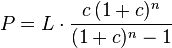
The fixed monthly payment P for a loan of L for n months and a monthly interest rate c is:
The fixed monthly payment P for a loan of L for n months and a monthly interest rate c is:
Abuses in lending
Predatory lending is one form of abuse in the granting of loans. It usually involves granting a loan in order to put the borrower in a position that one can gain advantage over him or her. Where the moneylender is not authorized, they could be considered a loan shark.
Usury is a different form of abuse, where the lender charges excessive interest. In different time periods and cultures the acceptable interest rate has varied, from no interest at all to unlimited interest rates. Credit card companies in some countries have been accused by consumer organizations of lending at usurious interest rates and making money out of frivolous "extra charges".
Abuses can also take place in the form of the customer abusing the lender by not repaying the loan or with an intent to defraud the lender.
Usury is a different form of abuse, where the lender charges excessive interest. In different time periods and cultures the acceptable interest rate has varied, from no interest at all to unlimited interest rates. Credit card companies in some countries have been accused by consumer organizations of lending at usurious interest rates and making money out of frivolous "extra charges".
Abuses can also take place in the form of the customer abusing the lender by not repaying the loan or with an intent to defraud the lender.
United States taxes
Most of the basic rules governing how loans are handled for tax purposes in the United States are codified by both Congress (the Internal Revenue Code) and the Treasury Department (Treasury Regulations — another set of rules that interpret the Internal Revenue Code).
1. A loan is not gross income to the borrower. Since the borrower has the obligation to repay the loan, the borrower has no accession to wealth.
2. The lender may not deduct (from own gross income) the amount of the loan. The rationale here is that one asset (the cash) has been converted into a different asset (a promise of repayment). Deductions are not typically available when an outlay serves to create a new or different asset.
3. The amount paid to satisfy the loan obligation is not deductible (from own gross income) by the borrower.
4. Repayment of the loan is not gross income to the lender. In effect, the promise of repayment is converted back to cash, with no accession to wealth by the lender.
5. Interest paid to the lender is included in the lender’s gross income. Interest paid represents compensation for the use of the lender’s money or property and thus represents profit or an accession to wealth to the lender. Interest income can be attributed to lenders even if the lender doesn’t charge a minimum amount of interest.
6. Interest paid to the lender may be deductible by the borrower. In general, interest paid in connection with the borrower’s business activity is deductible, while interest paid on personal loans are not deductible. The major exception here is interest paid on a home mortgage.
1. A loan is not gross income to the borrower. Since the borrower has the obligation to repay the loan, the borrower has no accession to wealth.
2. The lender may not deduct (from own gross income) the amount of the loan. The rationale here is that one asset (the cash) has been converted into a different asset (a promise of repayment). Deductions are not typically available when an outlay serves to create a new or different asset.
3. The amount paid to satisfy the loan obligation is not deductible (from own gross income) by the borrower.
4. Repayment of the loan is not gross income to the lender. In effect, the promise of repayment is converted back to cash, with no accession to wealth by the lender.
5. Interest paid to the lender is included in the lender’s gross income. Interest paid represents compensation for the use of the lender’s money or property and thus represents profit or an accession to wealth to the lender. Interest income can be attributed to lenders even if the lender doesn’t charge a minimum amount of interest.
6. Interest paid to the lender may be deductible by the borrower. In general, interest paid in connection with the borrower’s business activity is deductible, while interest paid on personal loans are not deductible. The major exception here is interest paid on a home mortgage.
Income from discharge of indebtedness
Although a loan does not start out as income to the borrower, it becomes income to the borrower if the borrower is discharged of indebtedness. Thus, if a debt is discharged, then the borrower essentially has received income equal to the amount of the indebtedness. The Internal Revenue Code lists "Income from Discharge of Indebtedness" in Section 61(a)(12) as a source of gross income.
Example: X owes Y $50,000. If Y discharges the indebtedness, then X no longer owes Y $50,000. For purposes of calculating income, this is treated the same way as if Y gave X $50,000.
Contact Us today for all your funding needs, including Loans, Project Finance, BG, SBLC, L/C.
EMAIL 1: loanandinvestments@outlook.com
EMAIL 2: ceo@loanandinvestments.com
Skype: loanandinvestments
NOTICE: Brokers are welcomed, appreciated and compensated. We pay 1% commission to our brokers and company representatives. If you want to be our broker or company representative in your country, EMAIL us for more information.
Example: X owes Y $50,000. If Y discharges the indebtedness, then X no longer owes Y $50,000. For purposes of calculating income, this is treated the same way as if Y gave X $50,000.
Contact Us today for all your funding needs, including Loans, Project Finance, BG, SBLC, L/C.
EMAIL 1: loanandinvestments@outlook.com
EMAIL 2: ceo@loanandinvestments.com
Skype: loanandinvestments
EMAIL 2: ceo@loanandinvestments.com
Skype: loanandinvestments
NOTICE: Brokers are welcomed, appreciated and compensated. We pay 1% commission to our brokers and company representatives. If you want to be our broker or company representative in your country, EMAIL us for more information.

